
Will artificial intelligence replace programmers? (2026 honest guide)
Key Takeaways:
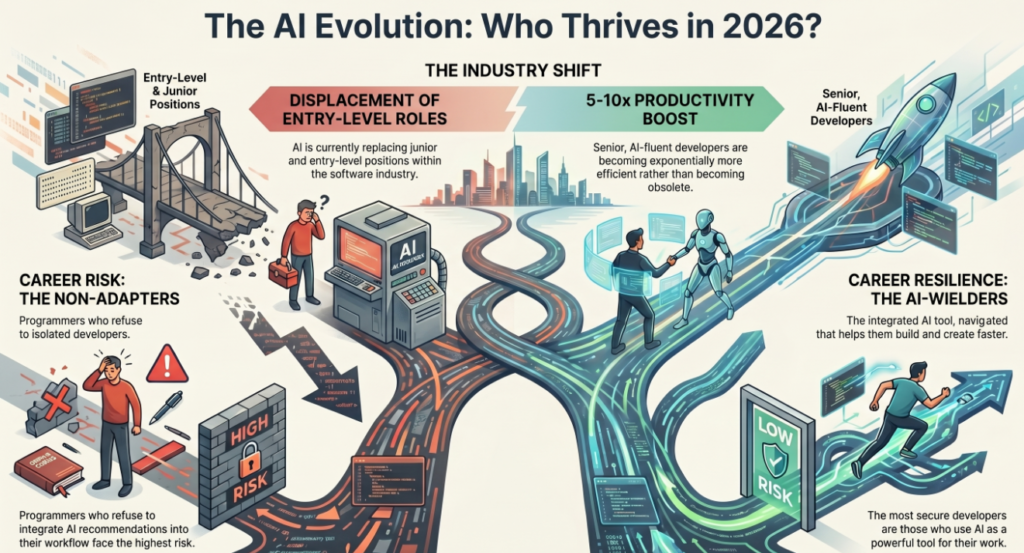
- AI is not replacing most programmers, but at this time, AI is already displacing junior and entry-level roles in the industry.
- Senior developers, AI-fluent developers are becoming 5-10x more productive, not obsolete.
- The programmer most at risk: those who refused to adapt to new technology on new AI recommendations.
- The safest programmer: those who wield AI as a powerful tool for their work.Will artificial intelligence replace programmers?
Will artificial intelligence replace programmers?
Will artificial intelligence replace programmers? The short and direct answer is: NO – not entirely and not anytime soon. As of 2026, It also can’t design complex software systems and other works on its own. Artificial intelligence also doesn’t truly understand business needs, make creative decisions, or take responsibility for legal and ethical issues. These are the main pillars of what professional programmers actually do every day.
But here is the honest part of more articles that don’t mention clearly: AI is already displacing some types of programming work- especially simple, repetitive coding tasks. In 2024, Salesforce CEO Marc Benioff said that the company would slow down the hiring of new software engineers because AI tools help their current teams become about 30% more productive and advanced. In the same year, a survey of 3000 developers showed that around half of them were using many types of AI tools as their main coding assistant.
So now the real question is not whether AI will replace all programmers – now the real question is which programmers are at risk, which ones are becoming more valuable and what developers should do next. This content guide covers all of that using real Data, expert inside and practical steps.
Will AI Replace Programmers? What the Data Actually Shows
Will AI replace programmers? The reality is more positive than what many headlines suggest.
In 2024, there were around 1.7 million software developers in the United States making it one of the biggest professional job fields. And this number isn’t shrinking, it’s growing. According to the data about 163 500 new jobs will be added in professional and technical services by 2035. That’s more than other job in that sector.
Yes, AI is changing how coating work is done. It can handle simple repetitive tasks like writing basic code or fixing small errors. But it is still can’t think like a human, understand real-world problems deeply, or make important decisions.
What Tasks AI Handles Well vs What Requires Human Programmers
Here is an honest side-by-side breakdown of where AI generally excels, and where it still fails:
| AI Can Do This Well | Still Requires a Human Programmer |
|---|---|
| Writing boilerplate and CRUD code | Architecting complex systems from scratch |
| Auto-completing standard functions | Long-term code maintainability decisions |
| Detecting and suggesting bug fixes | Debugging novel, context-specific logic errors |
| Generating unit tests | Security trade-off judgment calls |
| Translating code between languages | Understanding business domain requirements |
| Summarising code documentation | Taking accountability for production failures |
| Forecasting timelines with historical data | Inventing entirely new technical approaches |
Can AI Replace Full Stack Developer Roles?
Can AI replace full-stack developer roles completely? No, But it is changing how their work looks every day. Developers who mostly do simple tasks like basic CRUD operations, copying framework code, or writing standard front-end and layouts are most likely to feel the impact of AI. This kind of task is now easily handled by AI tools.
Full stop developers who understand how products work, can design systems well, and know how to use AI tools are not losing value in the industry – in fact, they are becoming more important than ever.
What’s happening in 2025-2026 is that one skilled developer who very well knows how to use AI cannot do the work that earlier needed a team of 34 junior developers. The distinction matters: it is not. Development at risk – the type of basic, repetitive full stack work is what is at risk. Developers who have strong skills in system design, database optimisation, APIs, and business logic will still remain silent, and I have secure jobs in the upcoming years.
Full-Stack task AI Can Automatic vs Tasks That Need Expertise
| AI-Automatable (Full-Stack) | Still Needs a Senior Full-Stack Dev |
|---|---|
| Standard REST API endpoints | Microservices architecture design |
| Basic React/Vue component scaffolding | State management in large-scale apps |
| Form validation boilerplate | Cross-browser performance optimisation |
| Simple database CRUD queries | Complex query optimisation and indexing |
| Routine unit tests | End-to-end integration strategy |
How Will Artificial Intelligence Affect Jobs in the Tech Industry?
How will artificial intelligence affect jobs across the tech sector these days? The impact of artificial intelligence is already visible and measurable – but not in the scary way many people thought. Instead of replacing everyone, AI is reshaping how work gets done. What’s really happening after the AI came is that entry level jobs are becoming harder to get,
while experienced developers are becoming even more powerful. Companies now expect more skills from beginners specially the ability to work with AI tools and the advanced skills in AI.
For example, jobs for junior developers (age 22-25) have dropped by about 20% compared to 2022, hiring of fresh graduates by big tag companies has also gone down by around 45% since 2019. But it doesn’t mean that programming is dying because of AI. It just means the way of the team’s work is changing now. One skilled developer who knows how to use AI in their work or how can I work on an advanced level they already secure their job in the Tech industries.
AI and Future Jobs: What Will Programming Look Like in 2030?
AI and the future of programming jobs are closely connected – but not in the scary way many programmers think. By 2030, programming jobs won’t disappear, they will change and grow with advanced AI skills. Developers who succeed will be the ones who use AI as a helpful tool in their work. Like a team or junior developers. Instead of being an affair of AI, they will guide it, check its work, and use it to get things done faster and better than previous.
Back in 2015, Gartner predicted that by 2025, over 70% of apps would be built using low-code or no-code tools. But instead of reducing opportunities in this area, low code developers actually start earning higher salaries these days and the demand of traditional developers keeps increasing.
This shows a clear pattern: when tools make it easier and cheaper to build software, more software gets created. And as a result, the need for skilled people to design, connect and maintain this system also grows.
The Rise of the Agentic Engineer
The most important new role in 2025 and 2026 is called the “Agentic Engineer” . These are the developers who do not write code by themselves instead, they guide AI tools, assign tasks, review output, fix mistakes, and combine AI-generated code into a real system. The top 20% of engineers who operate this way are becoming 5-10 times more productive than those who don’t use AI.
Top AI Tools Developers Are Using Right Now
In a 2025-2026 survey of 3,000 developers, the most widely adopted AI coding tools were:
- GitHub Copilot – GitHub Copilot
- Cursor– Cursor ( AI-native IDE)
- Claude – Claude by Anthropic
- ChatGPT-4o – ChatGPT
- Devin- Devin (autonomous coding agent, early stage)
These are some of the tools that developers use on a large scale to get their work done and these. tools help them to advance and speed up their work.
Will AI Replace Jobs in the Future?
Will AI Replace Jobs in the Future? Dancer is mostly the same across all industries, not just programming: AI can replace tasks, not entirely jobs. Jobs that mainly involve repetitive and predictable work are at a higher risk of being replaced. On the other hand, jobs that require decision-making, understanding context, creativity, responsibility, and human interaction are much safer in this time.
For programmers, job growth is actually strong. According to the BLS software development job are expected to grow by 16% by 2034, which is much faster than average. Worldmetrics also estimated that AI could create around 540,000 new software engineering jobs in 2025. The US economy is expected to add 5.2 million total jobs from 2024 to 20134 with data scientist and engineering among the fastest growing specific roles in this industry.
What Dario Amodei, Sam Altman, and Mark Zuckerberg Actually Predicted
Here is a simple and honest look at what top AI leaders predicted – and what actually happened;
| Leader & Prediction | What Actually Happened |
|---|---|
| Dario Amodei (Anthropic): AI writes 90% of code within 3-6 months (2025) | AI writes significant portions of implementation code, but humans still drive architecture and review. The prediction did not fully materialise. |
| Mark Zuckerberg (Meta): AI replaces mid-level engineers at Meta in 2025 | Meta and other big tech firms slowed junior hiring, but senior engineers became more productive, not replaced. |
| Sam Altman (OpenAI): Programming will be completely different by the end of 2025 | True in workflow terms — AI tools are now integral. But programming as a profession is growing, not dying. |
| Bill Gates: Coding is one of 3 jobs AI will not eliminate | Supported by BLS data showing 16% projected growth through 2034. |
Will AI Replace Programmers Who Adapt? No – Here Are 5 Skills to Stay Irreplaceable
Will AI replace programmers who actively learn to work with it? According to every major employment study, the answer is NO. The developers who will succeed in the next decade won’t be the ones who avoid AI, they will be the ones who learn how to use AI in their work. Based on hiring trains from 2025 -2026, here are the five most valuable skills to focus on
5 Skills That Make Any Programmer AI-Proof
- AI Tools Fluency – know how to give clear instructions to AI, guide it, and check its code. Use AI to enhance their knowledge or skills.
- System Architecture Thinking- understanding how big systems are built, and maintaining this is something where human thinking is still very important in work.
- Domain Expertise – having deep knowledge in a specific field (like fintech, healthtech, edtech, or defence) makes you much harder to replace someone who knows a little bit about everything.
- Prompt Engineering – being able to get accurate, high-quality code from AI tools is now an essential skill for developers, not just an extra advantage.
- Product and business Sense – Developers or workers who understand why they are building or creating something, not just how to build it, will always be valuable. AI does not have full business knowledge.
Frequently Asked Questions (FAQ)
Q1. Will artificial intelligence replace programmers completely?
NO. AI can never completely replace programmers. As of 2026, AI tools cannot architect complex systems, exercise creative problem- solving, or take accountability for production failures.
Q2. Will AI replace programmers who work at junior level first?
Yes, this can be said because this is already happening. Entry- level jobs that involve basic coding, simple CRUD tasks, and routine framework work are most at risk of being automated. According to some previous data, hiring of junior developers at Big Tech companies has dropped by about 20% since 2022. However, those who learn to use AI tools and show a good knowledge about and understanding of how systems work are still getting hired.
Q3. Can AI replace Full-Stack developer roles entirely?
No. This is not true because AI can handle some parts of a Full-Stack developer’s job, like simple front-end design, basic API creation, and common database tasks. But developers with strong decision-making skills, deep product knowledge, and effective use of AI tools are now even more valuable.
Q4. How will artificial intelligence affect jobs outside of programming?
Here we can say that AI is not replacing entire jobs, but it can take over certain tasks across many industries. Tasks that are repetitive and follow fixed patterns- like data entry, simple report writing, and basic customer support are most at risk.
Q5 What does AI and future jobs research say about software engineering by 2030?
Some research shows that software engineering is not going away by 2030; it will change and grow. AI will take care of repetitive coding tasks, while humans will focus more on designing the system, handlink security, and understanding business needs. A new type of developer, called an “Agentic Engineer”, is becoming important,
Conclusion
Will artificial intelligence replace programmers? Based on data available in 2026, including a report from BLS, McKinsey, and hiring friends at major Tech companies, shows the answer is NO. AI is a tool we can say is very powerful, but still needs skill to guide it, check its work and take responsibility for the result.
What AI is already doing is dividing programmers into two groups: those who learn and use AI to become much more productive, and those who don’t and become easier to replace. The real differences are not between humans and AI but between programmers who use agent toes who don’t.
The programmer who will be replace a not the ones who write code, but the ones who refuse to learn how to work with AI.
READ MORE
Google’s New Update for SEO 2026
Most Mind-Blowing Innovation: AI Summit Delhi 2026
